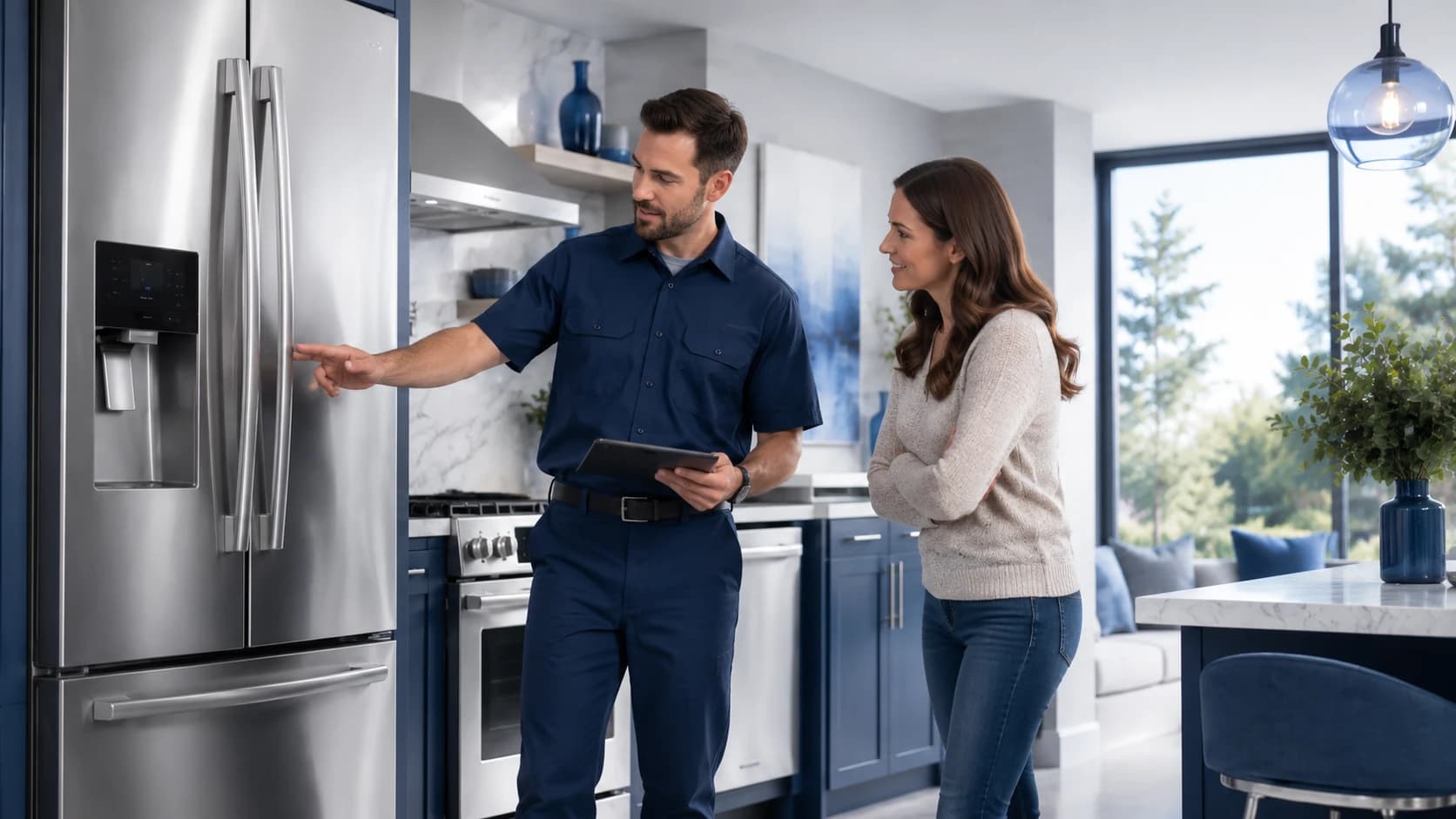
We diagnose it before we touch it.
Guesswork is what makes appliance repair expensive. Here is how we take it out of the job.
- verified OEM parts
- 4.8Mverified OEM parts
- error codes decoded
- 2,200+error codes decoded
- appliance brands
- 19appliance brands
- to a named fault
- ~11 secto a named fault
How it works
Four steps. No guesswork, no surprises.
Most shops send someone out to poke at it and hope. Here is what actually happens when you call us.
We pre-screen before we roll
You tell us the appliance, the model, and what it is doing. We screen it before the truck leaves, so the likely parts are already on board. That is why most repairs finish in a single trip instead of a diagnosis visit and a return visit.
We diagnose it on site
The technician finds the actual fault on your machine, in your kitchen. Not a guess from the doorway, and not a parts swap to see what sticks.
We verify it with ServiceLens
The diagnosis is checked against ServiceLens, the most complete appliance diagnostic platform there is. It is a built-in second opinion on every job, which is how the technician gets the right diagnosis the first time.
You approve, then we fix it
You get the price before any work starts, and nothing happens until you say yes. If parts need ordering, the technician handles anything else found along the way. You get an emailed invoice link and a PDF explaining exactly what was wrong.
What that gets you
- Pre-screened parts on the truck, so most repairs are one trip
- Completely transparent pricing, before the work starts
- A built-in second opinion on every diagnosis
- Emailed invoice link and a PDF that explains the diagnosis
What it costs
$120diagnostic
$60each extra appliance
The diagnostic is $120. That covers the diagnosis itself: we find the fault, verify it, and explain it. It is a service in its own right, not a deposit, so it is not credited toward the repair. Any additional appliance diagnosed on the same visit is $60. Parts are standard flat rate, and additional labor may apply depending on the job. You see the repair price before any work starts, and you decide.
Not sure what you need? Call (636) 367-1968 and we will tell you straight, before you book anything.
What it will not do
It will not replace the technician. A diagnosis narrows the problem to the likely component. Somebody still has to open the machine, confirm it with a meter, and do the work.
It will not make a bad repair worth doing. Sometimes the honest answer is that your fifteen-year-old dryer is not worth a control board. We will tell you that, and you will not pay us for the privilege of hearing it.
Good tools do not make an honest company. They just make it harder for an honest company to be wrong.
Fair questions
Is this just ChatGPT for appliances?
No, and the difference is the part that matters. A general chatbot will invent a part number that looks right and does not exist, because it is predicting text. ServiceLens is grounded on a verified corpus of real parts and real documented faults, and it flags when it is not confident instead of bluffing. A made-up part number costs you a return visit, so this distinction is not academic.
What does the diagnosis cost?
$120, and $60 for each additional appliance on the same visit. The ServiceLens verification is included in that, not billed on top. To be clear about one thing: the fee is not credited toward the repair. It pays for the diagnosis, which is a real piece of work and yours to keep. Parts are standard flat rate and additional labor may apply if you go ahead.
What if the diagnosis is wrong?
Then we eat it, not you. The upfront quote is what you approve and what you pay. If we brought the wrong part, that is our problem to fix, and the 90-day warranty covers the repair once it is done.
Do I have to talk to a robot?
Never. You talk to the technician. The diagnostic work happens before we arrive, on our side. Nobody is going to hand you a tablet and ask you to describe your dryer to an app.
Something broken right now?
Tell us the make and the symptom. We will tell you what it is likely to cost before we drive out.